
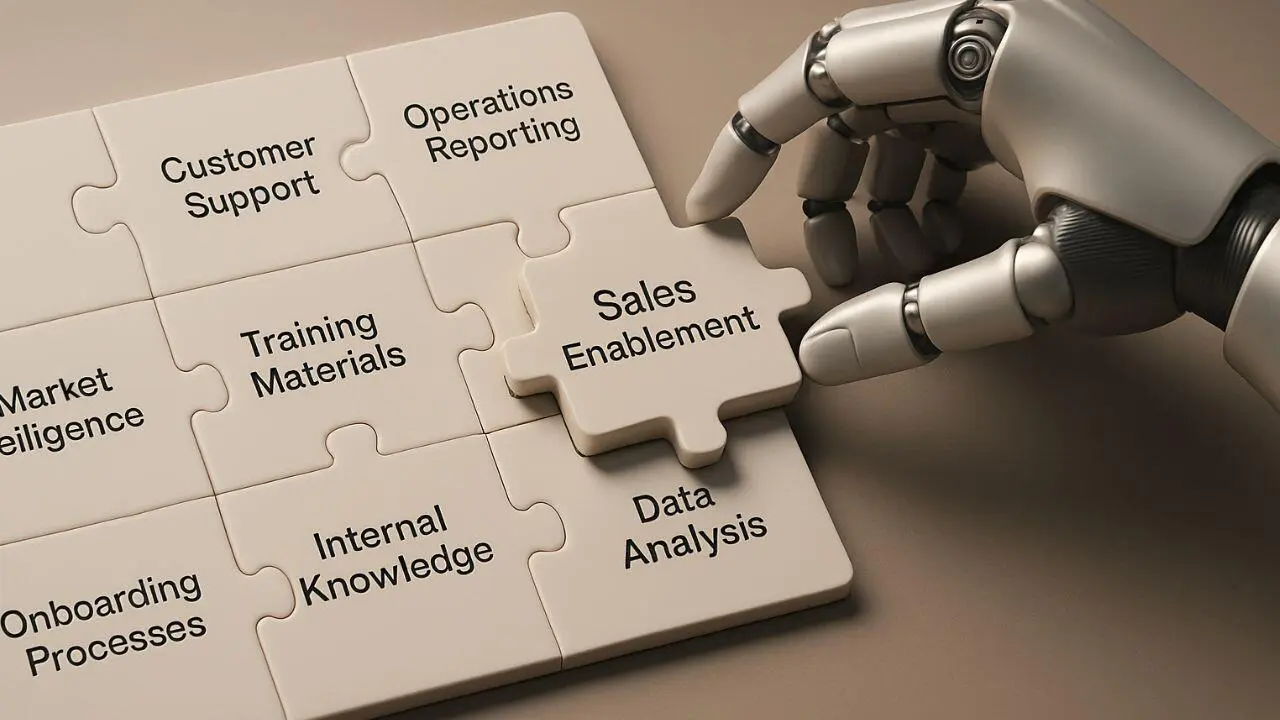
AI is everywhere – from ChatGPT writing emails to Gemini summarising meetings, AI agents answering customer queries, and tools generating full product videos from text prompts.
Despite all the hype, many business leaders are quietly asking the same thing: Where does this actually fit in my business?
This post kicks off my new series on AI for your business to help you cut through the noise.
Not to sell you AI, but to help you see if it’s even the right time to adopt it, and if yes, how to begin with what you already have.
First thing first. 👇👇👇
Are These 5 Signs Showing Up in Your Workflows?
- Your team is testing ChatGPT or other Gen AI tools — but only at an individual level, with no structured plan.
- You’ve got siloed systems (CRM, ERP, marketing tools) but no clear way to link AI into them meaningfully.
- You’re collecting tons of customer data, but it sits untouched because you “don’t have the bandwidth” or internal AI capability.
- There’s internal excitement (or FOMO) to adopt AI — but also frustration because no one knows what use case to begin with.
You’ve spoken to consultants or seen demos, but every solution feels too generic or too far from your business context.
If any of these sound familiar, your organisation may be more AI-ready than you think – you’re just missing a starting point.
Where AI Might Be a Game Changer – And Where It Might Not

AI can be transformative – but not for everything. For example, it’s brilliant at:
- Automating support with AI agents trained on your own knowledge base
- Creating first drafts of content, emails, ads, and even internal documents
- Analysing customer conversations at scale to spot sales trends or pain points
- Generating product images or marketing videos using text prompts
But it’s not ideal for decisions involving legal nuances, HR issues, or tasks that demand deep human empathy.
AI isn’t here to replace teams – it’s here to amplify them where the workflow is repetitive, data-heavy, or speed-critical.
What Starting Looks Like for Startups, SMBs, and Enterprises
- Startups can use AI to scale without adding headcount – auto-generating pitch decks, product descriptions, or outbound emails.
- SMBs can experiment with AI integrations within tools they already use – like adding Gen AI to their CRM or automating lead qualification.
- Enterprises can pilot custom LLMs or deploy internal AI agents for knowledge management, support desk triage, or operations reporting.
Each stage of growth brings different constraints – the trick is to map AI efforts to real friction, not shiny use cases.
Tools You Already Have That Can Power an AI Experiment
You don’t need a fresh tech stack to start with AI.
You likely already use Google Workspace, Microsoft Office 365, HubSpot, Slack, Notion, or Shopify – all of which now support native AI integrations.
Even tools like Zapier, Make (Integromat) or n8n allow you to connect ChatGPT with your existing workflows.
Have customer queries coming in via email?
You can summarise, categorise, and route them automatically using open-source models or simple API calls. The goal is not to build from scratch – it’s to supercharge what’s already working.
The “No-Excuse” Starting Point

If you’ve delayed implementing AI because it feels too technical, risky, or expensive – good news: you don’t need to start with a big bang.
Embed a ChatGPT bot into your website to answer FAQs. Use Google’s AI to auto-write product descriptions. Feed your helpdesk tickets into an AI model to spot patterns.
Run a “shadow” AI experiment alongside your team for a week – no commitments, just learnings.
Start with a use case that’s low-stakes but high-frequency. Let your team experiment. See where the friction lies, and then scale from there.
Before You Build, Reflect – and Ask
AI isn’t just about knowing the tech – it’s about knowing where your business is feeling the most drag, and whether that drag can be reduced by automation, intelligence, or smarter interaction.
This series will walk through practical, real-world applications, examples, and blueprints. But it starts here — with reflection.